


The Maven Mystery: Remote Viewing How NASA's Craft Was Lost

Introduction
The MAVEN craft incident on Mars marks the conclusion of NASA's Mars Atmosphere and Volatile EvolutioN (MAVEN) orbiter mission, which spanned a decade of exploration. On June 3, 2026, NASA officially announced the loss of the spacecraft, bringing an end to the $582 million mission that significantly contributed to our understanding of the Martian atmosphere. In December, a communications blackout resulted in the loss of contact with the craft. The timing of this incident coincided with the passage of 3I/Atlas, sparking speculation and various internet theories. However, it was not until well after the 0.19 AU flyby that MAVEN went silent.

Timeline of the Incident
December 4, 2025: MAVEN transmitted its final telemetry data before entering a communications blackout as it moved behind Mars. On December 6, 2025 The Deep Space Network reported no signals received from MAVEN. Subsequent analysis revealed that MAVEN had entered safe mode, spinning at a rate of 2.7 revolutions per minute, which disrupted its intended orbit. On June 3, 2026, after unsuccessful attempts to regain control, NASA declared the MAVEN mission officially over.
Cause and Current Status
The spacecraft's uncontrolled spin misaligned its solar panels, leading to battery depletion and a loss of power. Investigations suggest that either hardware failure or a meteoroid impact may have triggered this incident. MAVEN is projected to remain in a decaying orbit around Mars for the next 50 to 100 years before ultimately crashing onto the planet's surface.

Project and Viewers
The Target: 8724-1903
MAVEN (Mars Atmosphere and Volatile EvolutioN) orbiter, at the exact moment the unknown error occurred that prevented NASA from reestablishing communications.
Remote Viewers: Patricia H., Becca Nielsen, David Powell, and D.R.
Project Manager: John Adams
THE DATA
When we look at the sessions from these viewers, there are triking technical correlations with the actual MAVEN anomaly. Several core structural and kinetic descriptors in the sessions align well with its physical configuration and its known failure telemetry:
David Powell noted a "diamond shaped vehicle... spiraling" and sketched a "spiral configuration". Patricia H. drew an object with a note stating parts "1 and 2 are turning in 2 different directions". This mirrors the 2.7 RPM high-rate rotation tracking data recovered by NASA after MAVEN emerged from the shadow of Mars. Patricia's illustration effectively represents the visual physics of a stationary component trying to articulate against two rapidly counter-rotating masses to regain positioning. David's session is heavily saturated with terms like "software issues malfunction", "signals jamming", and "electrical disturbances". Becca Nielsen similarly noted a "square rectangular box like shape... mechanical... programmed... automated controller" that was "erratically out of sync".
MAVEN's breakdown was fundamentally a command-and-control and communication blackouts event, rendering its advanced software systems permanently unreachable. David repeatedly calls out "floating debris coming at me", "permanent damage to an aircraft", and a "debris feel". This perfectly matches the primary engineering hypothesis for the mission's abrupt end—an energetic structural event, such as a fuel tank rupture, which physically altered the spacecraft's orbital path.

Space-based Imagery
The "Aircraft" and "Cockpit" Overlay: David describes being "behind the wheel of a craft", seeing a "pilot or astronaut", a "shuttle pilot", and a "cockpit". Becca mentions a "roadway". Because MAVEN is an unmanned, robotic orbiter, there was no human pilot or physical steering wheel. It could be argued the viewers picked up on the velocity, trajectory, and computerized guidance systems of a vehicle in transit, translating it into an airplane or submarine cockpit. "Barely breathable air" with an AOL of Cydonia was mentioned by David. Becca notes an "ocean like terrain... like a submarine". Mars is a hyper-arid desert with a carbon dioxide atmosphere only 1% as thick as Earth's (hence "barely breathable"). However, MAVEN's exact scientific mission is to study how Mars lost its historic water oceans and atmosphere to space. The deep space environment combined with the mission profile very well could have bled through as "oceanic/sub-surface" and "coastal" concepts.
Speculative Timelines and Entities
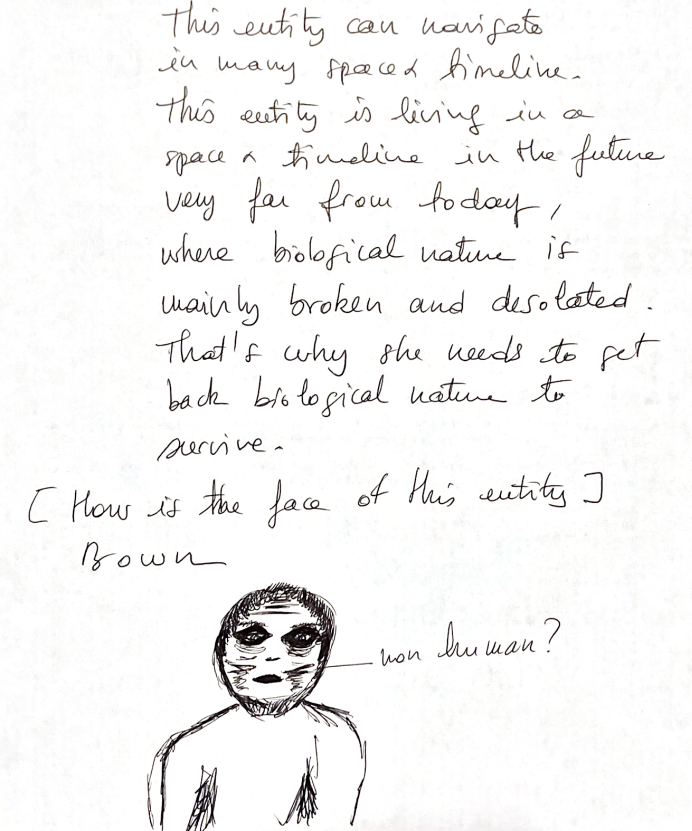
Where the sessions deviate from NASA engineering data is in the narrative regarding "future timelines," "non-human intelligence," and "clandestine operations." Patricia's pre- and post-feedback sessions focus heavily on a "multidimensional entity" traveling from the future to the past to collect "vegetal nature/life food" because their future biological nature is "broken and desolated." She sketches a "non-human" face and claims an advanced "holographic system" allows remote observation and intervention. David repeatedly notes "espionage", "sabotage", "nuclear war triad", and "adversaries in the skies."


The sheer frequency of words like spiraling, tumbling, software issue, signal failure, and mechanical rupture across separate blind viewers strongly hits on the exact engineering profile of the MAVEN disaster. The data effectively captures the energetic panic of a sophisticated machine losing control in the dark.
SKETCHES
Several sketches from the sessions are highly notable because they visually abstract MAVEN’s physical design, instruments, and its chaotic final moments.
When you strip away the conscious labels the viewers wrote down, the raw geometry tells a fascinating story.
Becca's sketch features a "spike-like probe" that "moves upwards" and "hollow tubelike tunnels". MAVEN carries a prominent, long Langmuir Probe and Waves antenna sticking out from its main structure to sample the Martian atmosphere, alongside fuel lines and instrument ports.

MAVEN's Langmuir Probe and Waves (LPW) antenna is a long boom extending from the spacecraft to measure the Martian ionosphere's characteristics. In the event of an energetic fuel tank rupture, which corresponds to the "metal molten" or thermal explosion aspect, this delicate probe would have been subjected to a sudden, violent upward kinetic force as the spacecraft experienced deformation.
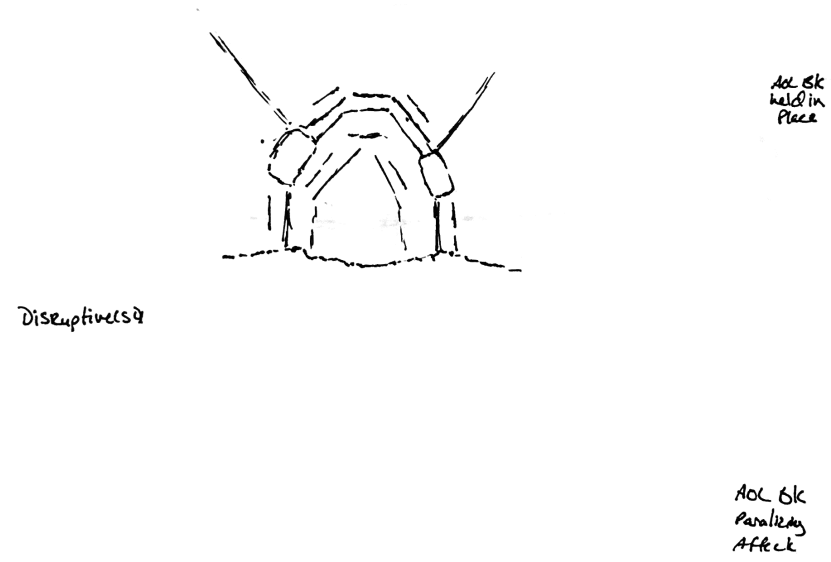
David's drawing depicts a central oval body with two long, angled mechanical arms labeled "Clamps?" along with notes that read "slanted frame, clamping, vibration, spinning darkness."

Meanwhile, D.R. sketches what appear to be clamps, metal, spinning, darkness, vibration, multiple parts, air flow, and a projectile.
The MAVEN parallel here is represented by the spacecraft's iconic wing-like solar arrays. Unlike flat, straight wings, MAVEN’s solar panels are uniquely gull-winged, featuring distinct slanted angles at the ends to enhance aerodynamic stability during deep structural dips into the Martian atmosphere, known as "aerobraking." David's sketch of a "slanted frame" closely resembles the silhouette of MAVEN's gull-wing solar panels as they vibrate during the spacecraft's tumble into the shadow of Mars.


The MAVEN craft incident marked the end of NASA's Mars Atmosphere and Volatile EvolutioN orbiter mission, which greatly enhanced our understanding of the Martian atmosphere. Was the loss of this craft conventional failure, as popularly believed, or was it the intervention of an outside force wishing to remain unknown? If so, it would mirror the compelling data around Phobos and Mars gleaned over the years. And further, could there be some kind of attempt to grow on or re-fertilize Mars? Patricia and Becca both alluded to these possibilities.
Patricia went on further to say:
(The) holographic system is a technology that allows some human and non-human intelligences to see remotely what’s happening inside. Looks silly but it is like the intelligence can act remotely as well. But probably due to the fact that they have remote access to things that can act on site. The people in the future know (or think) today that humanity is silly (because they know what happens in the future). Now they need to survive silently. They do not want us to know what they are doing.
David then summarizes at the end of the session with:
Upon the second pass, I'm getting radiological disturbances and rebounding affect. I'm picking up on ground surveillance and radar tracking. I get electrical disturbances in one of the aircraft here. This feels to be some event involving possibly a piloting error. I sense a spiral configuration and debris flying at someone calling out for help. There is an accelerated warning system here. Piloting, resistance training and an interpersonal relationship with the software, "informational", a highly sought after technology here. I am also sensing discontent for some are here and barely breathable air. I am sensing security threats around the globe and adversaries in the skies.

Notably, David also perceived the following: signals, signals jamming, and desperate maneuvers. He got a feeling of "like an aeronautical descent, flight risk, electrical disturbances, and a sense of rival, or rivaling", as well as the sense of subject in a space suit.
Conclusion
All things told, this project brings up some interesting questions, ones involving timelines - past, present, future - and more. It begs the question whether Mars could be visited or even inhabited by human or non-human intelligence. It highlights holographic technology, sensing technology, and maneuvers and hints at soil care, possibly for gathering or re-fertilization. It leaves us wondering how the MAVEN craft might really have been lost. But as usual, you can be the judge.


Comments